
Race Through Tokyo’s Iconic Spots by Go-Kart | A Sightseeing Route Guide for First-Timers
Looking Up at Tokyo Tower from a Red Light — A Moment You’ll Never Forget
Past the Shibuya intersection, you come to a red light and look up from your kart to see Tokyo Tower. The 333-meter steel tower floating against the evening sky hits differently at this distance — something you’d never get from a bus or train window. The wind brushes your cheeks, and beyond the exhaust fumes, you catch a faint hint of ocean air. When you see Tokyo from ground level, the city shows you an entirely different face. If this is your first time visiting Tokyo, it would be a shame to just follow the tour bus routes. Choosing a street go-kart completely transforms the way you experience the city’s most famous landmarks.
Shibuya, Harajuku, and Omotesando — Karting Through the Heart of Tokyo Culture
When it comes to must-see Tokyo destinations, the Shibuya, Harajuku, and Omotesando area is non-negotiable. Shibuya Scramble Crossing, widely regarded as one of the most famous intersections in the world, sees around 3,000 people crossing in a single green light. The impact of watching that scene unfold from a kart seat is worlds apart from experiencing it as a pedestrian.
Street Kart’s Shibuya location offers a tour course that covers Shibuya, Harajuku, and Omotesando in about one hour. Starting from the Shinsen area up Dogenzaka, the karts follow a guide through the zelkova-lined Omotesando boulevard and on toward Harajuku. Omotesando, with its architect-designed buildings lining both sides, feels like an open-air art gallery from the kart’s low vantage point. As you pass near the entrance to Takeshita Street, the colorful signs and bustling energy of young people radiate the unmistakable vibe of “kawaii culture’s birthplace.”
What makes this area so captivating is how Tokyo’s “now” is packed into just a few kilometers. Right next to redeveloped towers like Shibuya Hikarie and Shibuya Scramble Square, you’ll find the dense, ancient forest of Meiji Shrine. Feeling the contrast between urban energy and nature with the wind rushing past you — that’s an experience only a street go-kart can deliver.
Akihabara to Tokyo Station and Ginza — Where Old and New Tokyo Collide
Another classic route starts in Akihabara and heads toward Tokyo Station and Ginza. Leave the Akihabara electric town behind, and within minutes, the chaotic streetscape of anime shops and themed cafés transforms completely. Pass through Kanda’s antiquarian bookshop district, and suddenly the red-brick Tokyo Station building comes into view. Built in 1914 and fully restored in 2012, this structure has stood as Tokyo’s front door for over a century.
The kart continues on toward Ginza. When the Wako clock tower appears, the atmosphere shifts. Ginza Chuo-dori, lined with heritage department stores and high-end brand boutiques, exudes the sophistication of an upscale district. Traveling from Akihabara’s pop culture to Ginza’s tradition and elegance in just one hour of driving — that’s the beauty of this route.
Extend the course a bit further and you’ll pass along the Imperial Palace’s outer gardens. The wide-open space with the Nijubashi Bridge in the background is wrapped in a tranquility that contrasts sharply with the bustling districts you just left. The tree-lined avenue in front of the palace, where only the hum of the engine breaks the silence, is one of those moments that makes you want to take a deep breath.
Tokyo Bay Area — Rainbow Bridge and Tokyo Tower in One Trip
The course departing from the Tokyo Bay location takes about 1.5 to 2 hours, circling through Rainbow Bridge, Tokyo Tower, and the Odaiba area. Crossing the 798-meter suspension bridge in a street go-kart is an experience you can only have here. From the bridge, you get a panoramic view of Tokyo Bay, with the Fuji TV headquarters building visible on the opposite shore. Choose an evening time slot, and the waterfront glows golden in the setting sun.
Near Tokyo Tower, you’ll find yourself gazing up at the 333-meter structure from the Shiba Park side. The full, sky-reaching view of the tower fills your wide-open field of vision in a way no tour bus window could ever frame. This iconic symbol of the Showa era is illuminated with different seasonal lighting each night.
In Odaiba, you’ll pass by DiverCity Tokyo Plaza, where the life-size Unicorn Gundam statue stands. The futuristic scenery of the waterfront subcenter pairs perfectly with the go-kart experience. Before or after your tour, grab sushi at Toyosu Market or check out a teamLab exhibition — the bay area has enough to keep you busy all day.
Why Riders Choose Street Kart
Street Kart is known as a go-kart operator with guides specifically trained for international drivers. With a fleet of over 250 street-legal go-karts, they operate 8 locations — 6 in Tokyo, plus Osaka and Okinawa. Over 1.34 million customers have taken their tours, and they hold an average rating of 4.9/5.0 stars across more than 20,000 reviews.
Every guide is a certified staff member who has completed specialized training. They don’t just lead the way — they’re focused on delivering a genuine tour experience. Before each ride, there’s a safety briefing and kart operation walkthrough, all conducted under a system that fully complies with Japanese traffic law. Every vehicle undergoes regular inspections and holds proper certification for public road use. Full insurance coverage is included, so even first-time kart riders can participate with peace of mind.
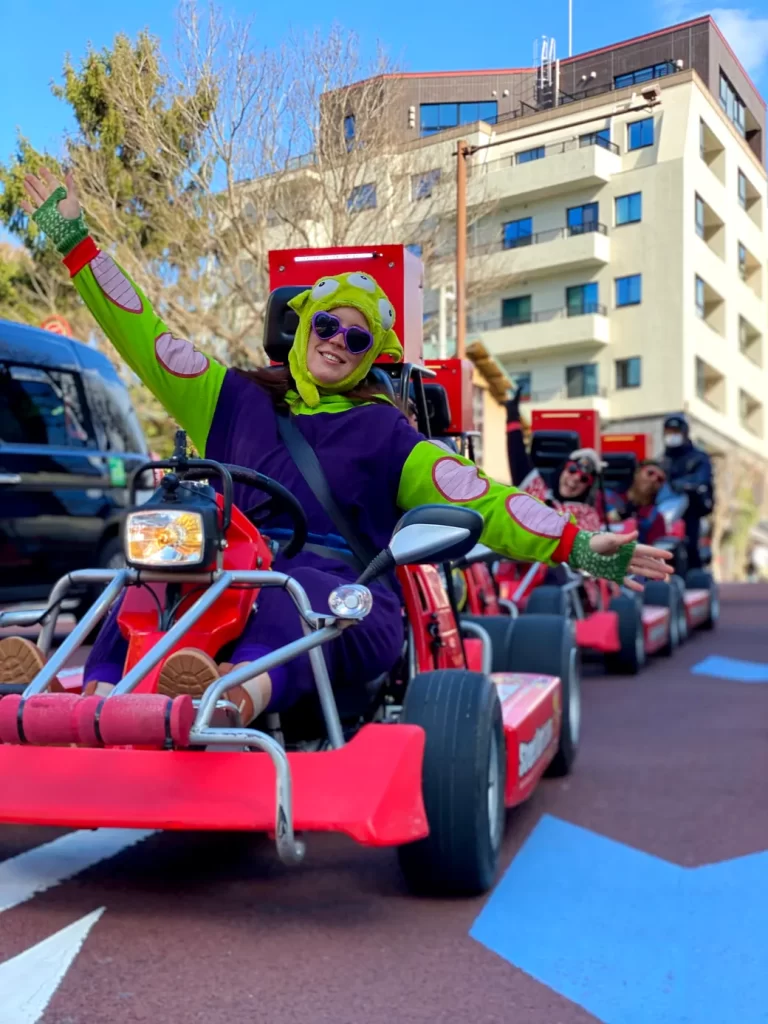
A photo service is also part of the tour — at red lights and photo spots, your guide will grab the camera for you. Since Japanese law prohibits taking photos while driving, this service is a lifesaver for anyone wanting to capture the memories. Costume rentals are also available, and details can be found on the official website.
Three Reasons to Choose a Go-Kart for Your First Tokyo Trip
Why recommend a street kart for your first time in Tokyo? For one, the journey itself becomes the sightseeing. Buses and trains are “a way to get to your destination,” but with a kart, “the time spent driving is the highlight.” The luxury of moving through Tokyo’s streets while absorbing it all with every sense is something no other mode of transport can offer.
Second, you can efficiently hit all the major spots even without knowing the area. Since it’s a guided tour format, you spend zero time fumbling with maps. You follow a set route, so there’s no chance of getting lost, and you can cover the key landmarks even with a tight itinerary.
Third, the intensity of the memories is on a completely different level. After you get home from your trip, what’s the experience you’ll want to talk about first? Tell someone “I drove through Shibuya’s Scramble Crossing in a go-kart,” and you can already imagine their reaction. Post it on social media, and the likes will exceed your expectations.
What to Know Before You Book
A valid driver’s license is required to participate in a street kart tour. Depending on your nationality, you may need an International Driving Permit or a license from a specific country along with an official Japanese translation. Check the details on the official website.
Reservations can be made at kart.st, and booking 2 to 4 weeks in advance is recommended during peak seasons. The most popular time slots are 2:00–4:00 PM for optimal photo conditions and 5:00–7:00 PM for night views. Weekdays are easier to book and have less traffic, so if your schedule allows, early afternoon on a weekday is your best bet. Wear sneakers and comfortable clothes. Helmets and goggles are included with the tour, so you can show up practically empty-handed.
Tokyo’s iconic sightseeing spots are perfectly enjoyable on foot or by train. But the experience of tearing through the city at almost ground level paints your memories of this place in entirely different colors. The bustle of Shibuya, the quiet elegance of Ginza, the sweeping views from Rainbow Bridge. For course details and tour availability, check here. Consider adding a street kart to your next Tokyo travel plans — you won’t regret it.

